Brocade and Cisco SAN, from basics to advanced.
10 detailed guides and 130 sections connect switch commands with prerequisites, worked examples and the evidence that proves a change succeeded. Follow one vendor path in order, then use the other to compare the same operational task.
Start with the FC foundation
- FC SAN switch foundations: hardware, fabrics, logins and storage access
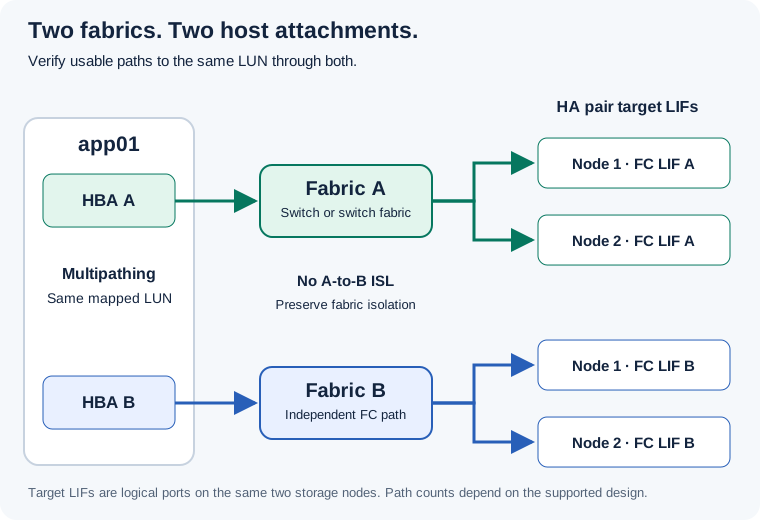
Build the two-fabric worksheet, install and label hardware, understand WWPNs and logins, and trace a host-to-LUN connection.
Identify both host initiators, the target LIFs, physical fabrics, logical contexts and expected usable paths before making a change.
Brocade SAN switches · Fabric OS
The command examples use the FOS 9.2 references. Hardware, feature licensing, Virtual Fabrics and firmware paths require the matching platform and release.
- Brocade SAN basics: installation, management, ports and FC logins
Basic: hardware commissioning, console/management access, FID context, endpoint ports, directory and health checks.
- Brocade zoning: aliases, effective configurations and Peer Zoning
Intermediate: WWPN aliases, conventional zones, defined/effective configuration, Peer Zoning and scoped reversal.
- Brocade advanced: ISLs, trunking, Virtual Fabrics and FOS upgrades
Advanced: fabric joins, ISLs/trunks, Virtual Fabrics, Access Gateway, complete backups and FOS upgrades.
- Brocade troubleshooting: ports, zoning, segmentation, optics and slow drain
Practice: offline ports, missing logins, segmentation, trunk failures, optical errors, slow drain and lost paths.
Add an approved host without removing existing effective zones, explain its path and recover from a diagnosed fault with accepted client service.
Cisco SAN switches · MDS NX-OS
These lessons cover MDS 9000 native Fibre Channel with NX-OS 9.x. Match the exact hardware and release before using a feature or upgrade procedure.
- Cisco MDS basics: installation, initial setup, VSANs and FC host ports
Basic: hardware and management setup, VSANs, F ports, FLOGI/FCNS and protected configuration backups.
- Cisco MDS zoning: pWWNs, aliases, basic mode and enhanced commits
Intermediate: pWWNs, aliases, active/full/pending state, basic activation, enhanced commits and recovery.
- Cisco MDS advanced: ISLs, FC port channels, NPV and NX-OS upgrades
Advanced: E/TE ISLs, FC port channels, NPV/NPIV, architecture boundaries and impact-qualified NX-OS upgrades.
- Cisco MDS troubleshooting: missing LUNs, isolated VSANs and slow drain
Practice: isolated VSANs, missing targets/LUNs, channel members, CRC errors, TxWait and client acceptance.
Explain the difference between registration, effective zone permission and storage presentation, then prove the intended VSAN and host service after a scoped change.
Interview and scenario practice
- Brocade and Cisco SAN interview questions: basic to advanced scenarios
32 explained answers: 8 basic, 8 intermediate, 8 advanced and 8 scenario questions, including evidence and operational decisions.
For each answer, give the object identity, context, next command, expected result and the observation that would make you stop and investigate.
Use the examples with your own lab record
Commands and synthetic outcomes are documentation-based teaching examples, not live switch test captures. Keep your actual model, software, licenses, switch/FID/VSAN, physical port/index, WWPNs and application owners in the worksheet. Read-only inspection, configuration changes, exports and disruptive migrations are labeled in the guides.
Postchecks cover effective policy, hardware and fabric health, expected endpoint logins, running firmware where applicable, host multipath state and real application I/O. Use the wider storage postcheck guide to connect fabric acceptance with ONTAP and protection service.